
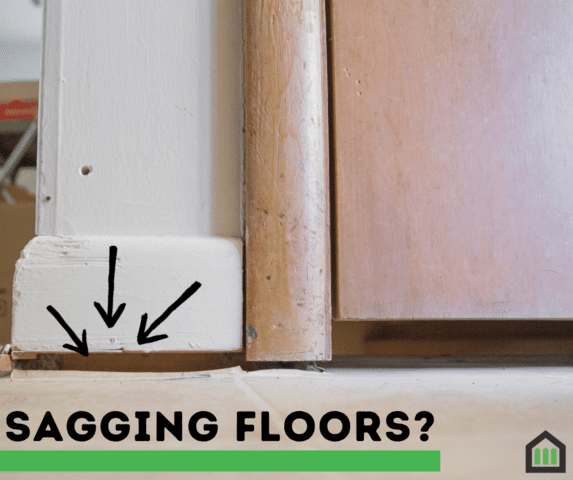
That small gap between the floor and the baseboard. The way a room seems to tilt slightly to one side. Or that unmistakable bounce when someone walks across the living room. At first, these might seem like minor quirks you can ignore. But these subtle shifts are often the first signs of sagging floors. They point to bigger issues happening below the surface, usually in your crawl space or foundation. Understanding what these signs mean is the first step to restoring your home’s stability and your peace of mind.
Unfortunately, sagging or sloping floors are an issue that most often gets worse over time. It can be a sign of foundation issues within a crawlspace.Severe damage to your foundation can develop immediately following construction, or years later as changes occur within the soils surrounding and support your home. Sagging uneven floors aren’t just unsightly – they can pose safety hazards to those living in the house. Read our guide to evaluating a home with sagging floors for more information.
When a crawl space is built, block or brick or even wood – columns are located throughout the crawl space to support the structure’s weight above. Sometimes these columns settle over time, and as they sink, they provide less stable support to a home and the floors above. Other times, the columns may have been placed too far apart, to begin with, and the support beam or girder linking the columns and helping to hold the structure upstarts to sag, causing a ripple effect.
Finally, if the columns and other materials inside the crawlspace are made of wood, exposure to natural elements could cause deterioration over time.
These problems with a foundation are best fixed by a contractor who specializes in crawlspaces. Vesta Foundation Solutions has years of experience helping homeowners restore the safety of their homes. We offer exclusive products that can replace the affected columns and beams, causing the issue, permanently stabilizing the home’s foundation. Our lifetime warranty backs our confidence in our work.
The process starts with a no-obligation inspection of the house and a presentation of our findings. To ease worry and redeem peace of mind, schedule your appointment today!
Frequently Asked Questions
Are slightly bouncy or uneven floors really a big deal? It’s easy to get used to a little bounce or a slight slope, but these are often the first hints of an underlying structural problem. Think of them as early warning signs from your home’s foundation. Addressing them sooner rather than later can prevent the issue from growing into a more significant and complex repair down the road. It’s about maintaining your home’s structural integrity for the long haul.
My house only has a crawl space. Can that still cause my floors to sag? Absolutely. In fact, the crawl space is the most common source of sagging floors. The support posts within the crawl space can settle into the soil over time, or they might have been spaced too far apart during construction. If the supports are made of wood, moisture can also lead to rot and weakening, which reduces their ability to hold up the weight of your home.
If I ignore my sagging floors, what could happen? A sagging floor is a symptom of a support system that is failing. Over time, this lack of support can lead to more noticeable problems throughout your house. You might start to see cracks in your interior drywall, doors that stick or don’t close properly, and even larger gaps forming. The problem rarely fixes itself and typically worsens as the underlying issues continue.
How is a sagging floor actually fixed? The goal of the repair is to provide permanent, stable support for your floors and foundation. This usually involves installing heavy-duty, adjustable steel supports in the crawl space. These supports are designed to replace the failing original columns, lift the floor and beams back toward their original position, and permanently stabilize the structure. It’s a solution that addresses the root cause of the problem.
What’s involved in getting an inspection? An inspection is a straightforward first step. A specialist will visit your home to thoroughly assess your foundation and crawl space to identify exactly what’s causing the floor to sag. Afterward, they will walk you through their findings and explain what they discovered. This gives you a clear picture of your home’s health and allows you to understand the specific situation without any pressure or obligation.
Key Takeaways
- Recognize the early signs: Small changes like gaps near your baseboards, a bouncy floor, or a slight slope in a room often point to larger issues with your home’s structure.
- Understand the root cause: Sagging floors are usually a symptom of problems in the crawl space, such as support columns that are settling, spaced too far apart, or damaged by moisture.
- Act sooner rather than later: Foundation and crawl space problems typically worsen over time, so scheduling a professional inspection is the most reliable way to diagnose the issue and find a permanent solution.
Related Articles
- Signs of Sagging Floors | Foundation Repair & Basement Waterproofing
- Reinforcing Crawl Space Stability with SmartJack® Support Systems | Foundation Repair & Basement Waterproofing
- Uneven Floors | Foundation Repair & Basement Waterproofing
- Crawl Space Support Posts | Foundation Repair & Basement Waterproofing
- Floor Problems | Foundation Repair & Basement Waterproofing